Artificial Intelligence is a powerful capability within our platform. It can accelerate test creation, simplify complex logic, reduce maintenance effort, and help you validate dynamic content that would otherwise require advanced scripting.
However, like any powerful tool, AI should be used thoughtfully.
This article outlines best practices to help you maximize value from AI while maintaining stability, predictability, and long-term maintainability in your automated tests.
1. Use AI When It Adds Clear Value
Our platform includes powerful built-in automation capabilities designed specifically for ERP and cloud applications. These capabilities are:
Deterministic
Predictable
Easier to debug
More stable over time
Recommendation:
Always prefer built-in, structured automation steps when they can achieve the required outcome.
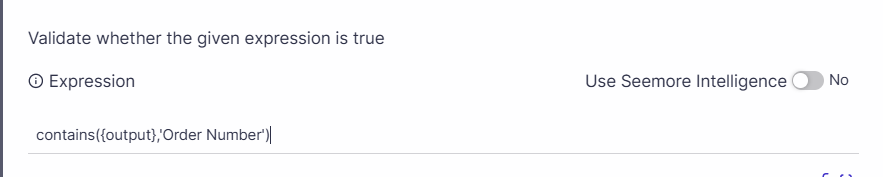
For example, you can use functions and parameters to enter or validate dynamic text:
When to Prefer Built-in Capabilities
Use native steps and predefined logic for:
Field validations
Data comparisons
Structured UI interactions
These options are optimized for automation reliability and long-term maintenance.
When AI Is the Right Choice
AI is best used when:
The expected result is semantic rather than exact
The application output varies but should convey the same meaning
Complex interpretation or transformation is required
A standard automation step would require heavy customization
Examples include:
Comparing texts or images with meaning-based similarity
Simplifying complex logic
Use AI to simplify complexity — not to replace reliable built-in steps.
The strongest and most recommended pattern would be to combine the AI and built-in capabilities and wrap AI usage with deterministic validation where possible. This approach provides both flexibility and stability.
2. Treat AI as Adaptive, Not Deterministic
Unlike predefined automation steps, AI responses may:
Vary slightly between executions
Improve or shift over time
Be influenced by prompt wording
This flexibility is powerful — but it also means AI is not inherently deterministic.
Best Practice
Before promoting a test to production:
Execute it multiple times during initial implementation
Run it across different environments if relevant
Confirm consistent and reliable results over time and after tool version upgrades
If results vary unexpectedly, refine the prompt or consider whether a built-in capability would be more appropriate.
3. Write Clear, Structured Prompts
The quality of AI output depends heavily on the prompt.
Tips for Effective Prompts
Be specific about what you expect
Define constraints clearly
Avoid ambiguity
Provide context when necessary
Specify the format of the expected answer if relevant
Example
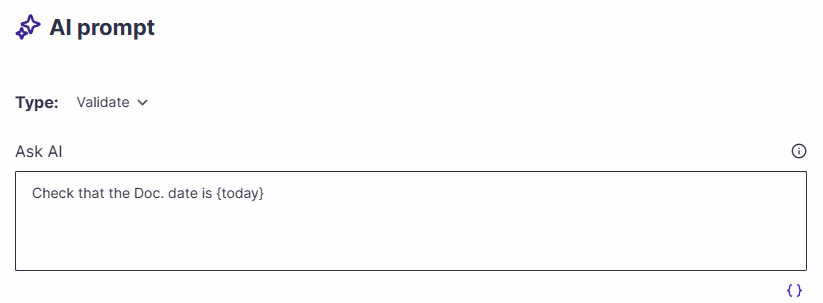
Less effective:
More effective:
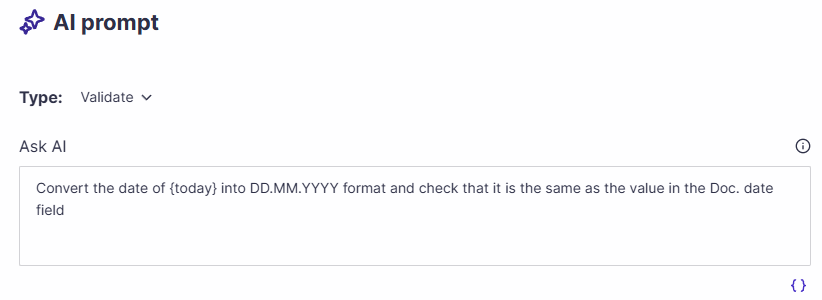
Small refinements in wording can significantly improve consistency.
If the result is not what you expected:
Adjust phrasing slightly
Clarify the expected format
Narrow the scope of interpretation
Prompt tuning is a normal and expected part of using AI effectively. AI improves outcomes when guided clearly.
4. Keep AI Logic Transparent and Maintainable
For long-term maintainability:
Where applicable, document why AI was used and the intention of the prompt
Avoid overly complex, multi-purpose prompts
Keep AI steps focused and narrow in scope
Future maintainers should understand:
What the AI step is validating
Why AI was chosen instead of a standard step
What is the expected AI response
5. Troubleshooting AI-Based Steps
If an AI step behaves unexpectedly:
Re-run the test to confirm consistency.
Review the prompt for ambiguity
Simplify the request.
Consider whether a built-in capability is more appropriate.
Remember: AI is a tool to simplify automation — not to replace good automation design.
Summary
AI is a powerful accelerator within our codeless test automation platform. It can be applied to tasks that might not otherwise be feasible but often comes with reduced predictability in the outcomes.
Used correctly, it can:
Simplify complex validations
Reduce maintenance effort
Enable semantic and flexible verification
Improve automation coverage
However:
Built-in capabilities should always be your first choice.
AI should be used when it clearly adds value.
Prompts may require refinement.
Results must be validated for consistency.
Stability should always take priority over novelty.
By applying these best practices, you can confidently leverage AI while maintaining a robust, scalable, and reliable automation suite.